

Endurance Blogs

Tag >> ramblinrose


By Joe Nuss


BY STEVE LACKEY


Like every year, 2009 has delivered so many awesome moments for so many people.  But more than any other in memory I am ready to let it go and leap freely into the new year. 


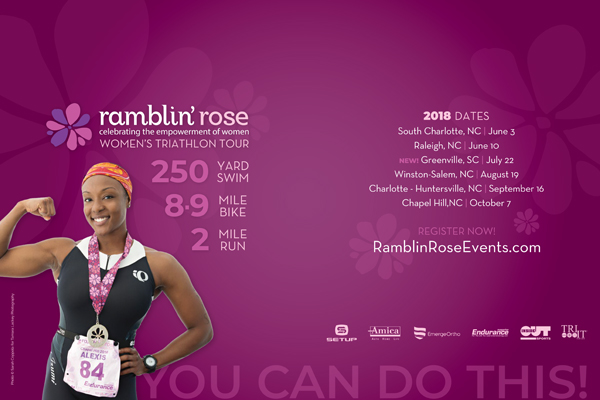
The cold rain was coming down so hard Alyse Kelly-Jones had almost decided to not run the Ramblin' Rose triathlon in Chapel Hill. That's when she saw the 8-year-old girl and her mother.

"A lot of people didn't even start the race, but she not only started, she finished," Alyse said. "I later found out she also helped another little girl run the race. This little girl acted as a mentor to another little girl and her own mother. I was inspired."

Alyse realized if an 8-year-old girl could help to change lives like that, then surely an obstetrician/gynecologist at Mintview Women's Care with years of experience in triathlons could do the same.

"Every day in my practice I see women, overstressed and downcast, who need a change in their lives. I know these women could benefit from participating in multi-sport training, but I'd never thought about how," Alyse said. "Then I remembered that little girl."


If you're looking for your first wetsuit or just a good suit to get you through the early season cold water races, the Orca S2 is the wetsuit for you. Orca is probably better known for their high-end wetsuits, selling for well over $500. Based in New Zealand, Orca has traditionally focused sponsorship on ITU and Olympic triathletes, most of them Australians, Kiwis, or Europeans. It is not surprising then that in the U.S., Orca is not as much a household name as Blue Seventy or Quintana Roo. However, their experience in making wetsuits dates back to the mid-1990s, and they sponsor athletes like Craig Alexander, who won the world 70.3 distance title using an Orca wetsuit during the swim.

Orca actually hit the U.S. market more than 10 years ago, with sleek looking black wetsuits with some white patterns that resembled those of the killer whale by the same name. The suits performed well, but sizing and fitting were an issue: they seemed to be made only for the lean athlete with 3% body fat. The average age-group athlete had a horrible time getting one of those suits on. Distribution was also a problem, as the suits came from Southeast Asia and the U.S distributor never seemed to be able to fulfill orders in a timely way. Better knowledge of the U.S. market and new relationships has changed all that. The current Orca wetsuit sizes now fit age-group athletes even better than some U.S. competitors, and a distribution partnership with Orbea bikes has ensured prompt availability in the U.S.

The S2 builds on the success of Orca's S1 wetsuit but uses a lighter, more flexible neoprene. It is a no-frills suit, but incredibly functional. It offers all the basic features that are necessary for a swimming wetsuit to work without the gimmicks that are often found in other wetsuits.

The material used is a water-resistant neoprene with a smoothskin outer layer that is durable and yet flexible. Orca uses varying thicknesses in different parts of the suit to achieve the perfect balance between buoyancy and flexibility. Generally, the thicker the material, the more buoyancy it will provide. In turn, the thinner the material, the more flexible it will be. The 5 mm "HydroLift" panels are strategically used on the front and back of the legs as well as front torso to provide outstanding buoyancy and warmth. The 3-mm back offers more flexibility and helps prevent overheating. The 3-mm "Flexiseal" Neck provides flexibility and comfort in an area that can be troublesome for a lot of athletes. Finally, the 3-mm Speed Transition Calf Panel ensures a fast wetsuit removal in transition. This is a nice touch for an entry-level suit. Anyone who has ever watched a triathlon transition knows that it is the novices that have most trouble getting off their wetsuits.


Endurance Magazine's Ramblin' Rose Women Only Triathlon Series wrapped up in October and capped off an amazing first year of our "green" initiative, "Race Without A Trace".  All of the athletes who participated in the series, as well as the Carroboro Classic Endurance Festival, The Tarheel 10-Miler and Franklin 5000 helped contribute to a cleaner environment with respect to the amount of event-related waste they reduced and recycled. 

Rather than hand out throw-away plastic bottles at the finish, the Endurance Magazine/Sport Often team hands out re-useable plastic bike bottles participants can use to fill up at one of our many water stations.  In addition, race packets including flyers and coupons are all distributed digitally via e-mail.  Shirts, bags, and other items are handed out at packet pick-up without plastic bags as well.

Earlier in the year, it wasn't unusual to find our team sorting compost, recycling, and trash in the few bags of waste generated at our events.  As the year wore on and more people became aware of our different recycling, trash and compost bins, our job became easier and the environment a little bit cleaner! 


Banner
Banner
Banner
Banner

Tags